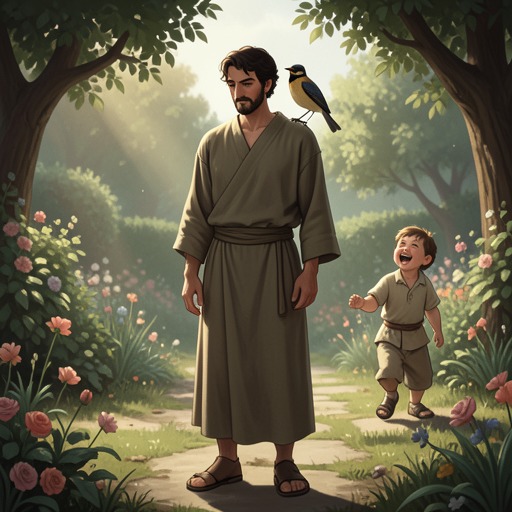
“The sticky little leaves”
The Brothers Karamazov“The sticky little leaves” names the small, bodily love of life that Ivan cannot reason himself out of, even when he cannot believe in the order of the universe. First offered as an image of spring growth, the leaves return in his exchange with Alyosha as a measure of what Ivan still loves and as the memory through which he promises to remain connected to his brother. The phrase gathers a contradiction without resolving it: Ivan’s doubts persist, but so does his longing to live.
The Image and Its Meaning
Ivan places the leaves among the particular things that draw him toward life: the blue sky, certain people, and great human deeds. His affection is not presented as a conclusion reached by argument. He says that he loves “with one’s inside, with one’s stomach,” locating the attachment in physical feeling rather than intellectual judgment. The spring leaves matter precisely because their appeal does not depend on his confidence in a rational or just universe.
That contrast gives the image its force. Ivan says he may no longer believe in the order of the universe, yet he continues to love the leaves as they open in spring. His uncertainty about the whole does not erase his response to a particular living thing. The leaves therefore stand not for a proof that his doubts have been answered, but for an attachment that survives without such proof.
Tears, Feeling, and the Desire to Live
Ivan links this love to tears, but distinguishes them from despair. He imagines weeping because he is happy in his tears and can steep his soul in emotion. In this account, feeling is not a solution to his intellectual conflict; it is a mode of being alive within it. The leaves and the blue sky bring his attention down from abstract judgments about the universe to an immediate, inward response.
The phrase also belongs to Ivan’s declaration that he wants to live on to thirty. His desire for life coexists with his doubts rather than following from their resolution. The recurring spring image makes that desire concrete: what he loves is not a theoretical defense of existence but the opening leaves themselves, joined to the sky and to the people for whom affection arises without explanation.
The Leaves Between Ivan and Alyosha
When Alyosha challenges him over how he can continue loving the leaves, the blue sky, and the woman he loves while carrying what Alyosha calls a hell in his heart and head, the image becomes part of a direct disagreement between the brothers. Alyosha presses the contradiction; Ivan does not answer by claiming that it has disappeared. Instead, when they leave the restaurant and part ways, he says that if he can care for the sticky little leaves, he will love them while remembering Alyosha.
That return changes the phrase’s emphasis. The leaves remain an object of Ivan’s attachment to life, but their meaning is now bound to the person who has questioned him and listened to him. Ivan tells Alyosha that knowing he is somewhere nearby is enough for Ivan not to lose his desire for life yet, and offers this as a declaration of love. The image thus carries both a sensory attachment to the world and a personal bond that helps keep that attachment alive.
Recurrence and Significance
The phrase moves from spring growth to a shared reference between the brothers. At first, it expresses how Ivan can love a particular natural thing despite his doubts about the universe; later, it returns in the moment of separation as a way of naming his remembered connection to Alyosha. Its significance lies in that movement, not in a claim that the leaves settle Ivan’s arguments.
The image holds together what the conversation leaves unresolved: disbelief in cosmic order and an unextinguished desire for life, intellectual resistance and feeling, separation and affection. Ivan’s love of the leaves is neither a philosophical refutation nor a passing ornament. It is the small, concrete measure by which he recognizes that his capacity for attachment remains—and by which he tells Alyosha that their bond is part of what sustains it.